Laplacian Frequency Hierarchies for Efficient 3D Gaussian Splatting Training
A plug-and-play frequency-staged training scheme for accelerating 3DGS backbones such as FastGS and Taming-3DGS.
1Harbin Institute of Technology, Shenzhen, China
2XGRIDS, China
*Equal contribution
†Corresponding author
Abstract
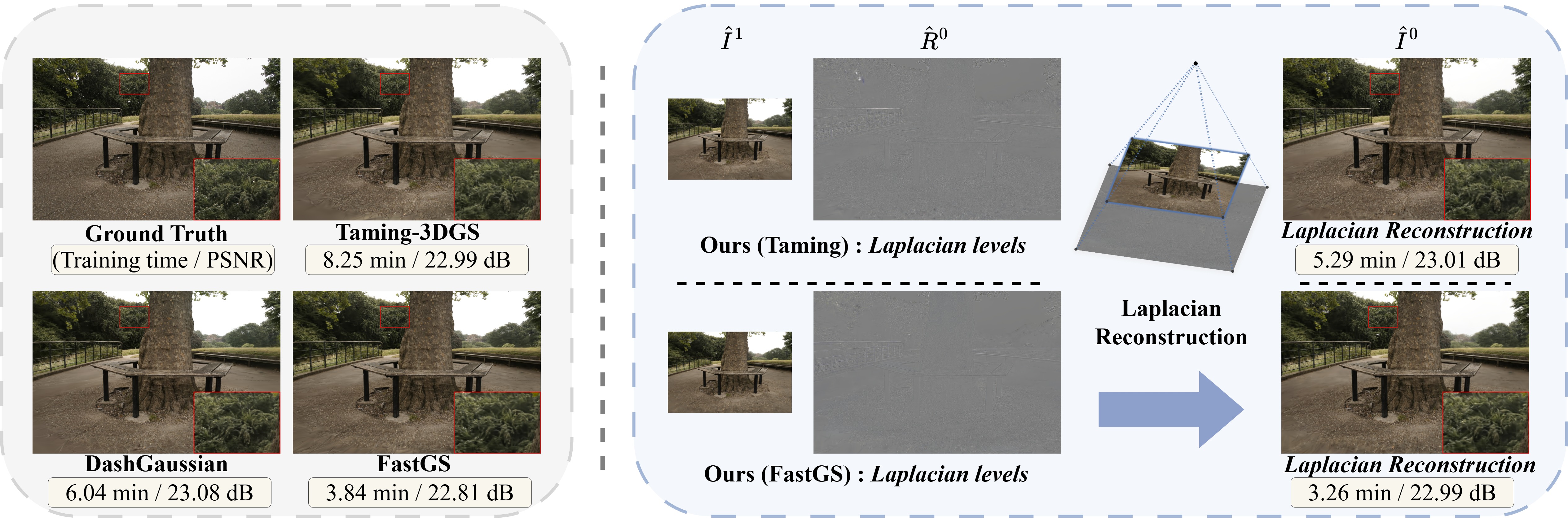
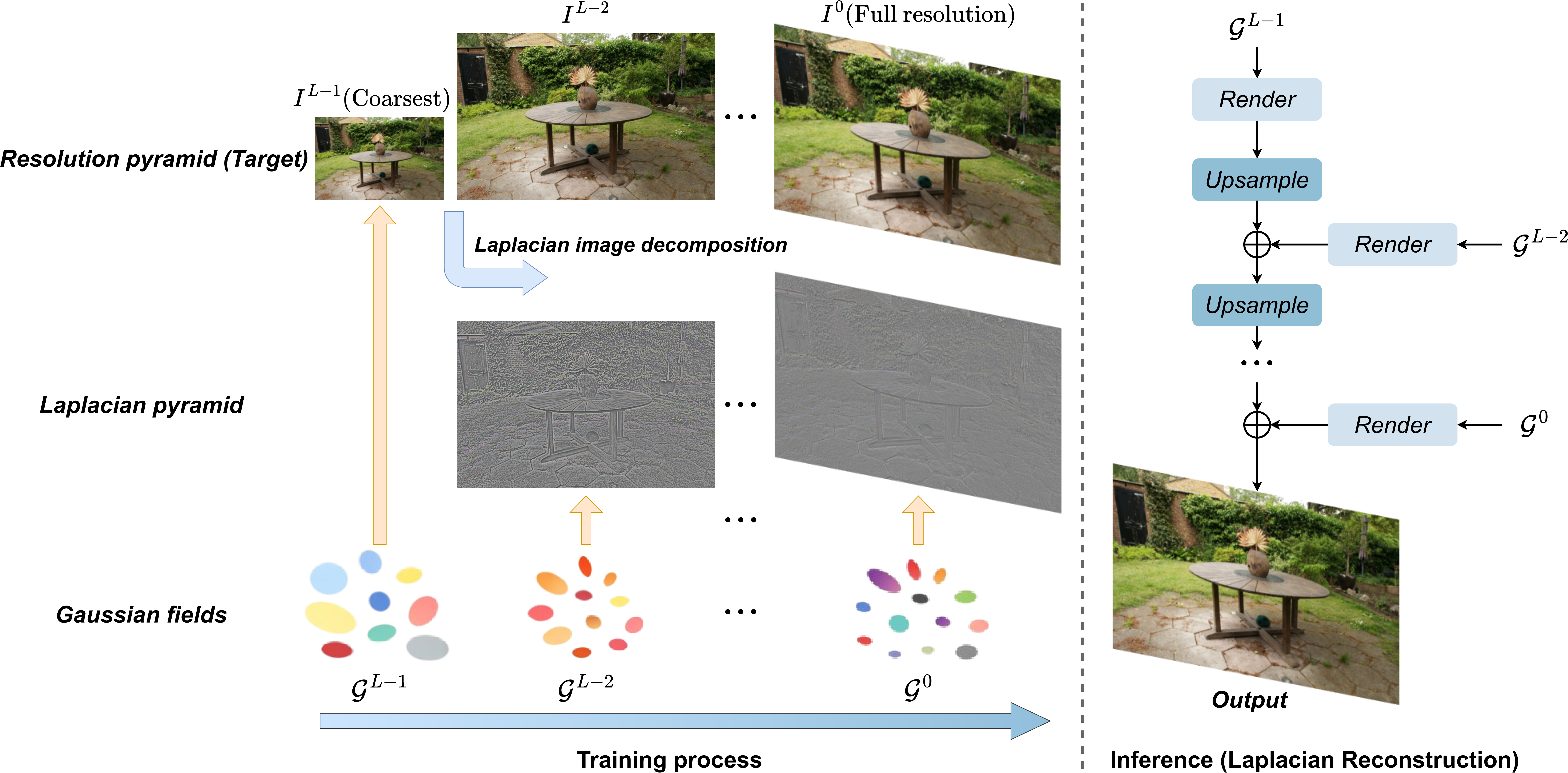
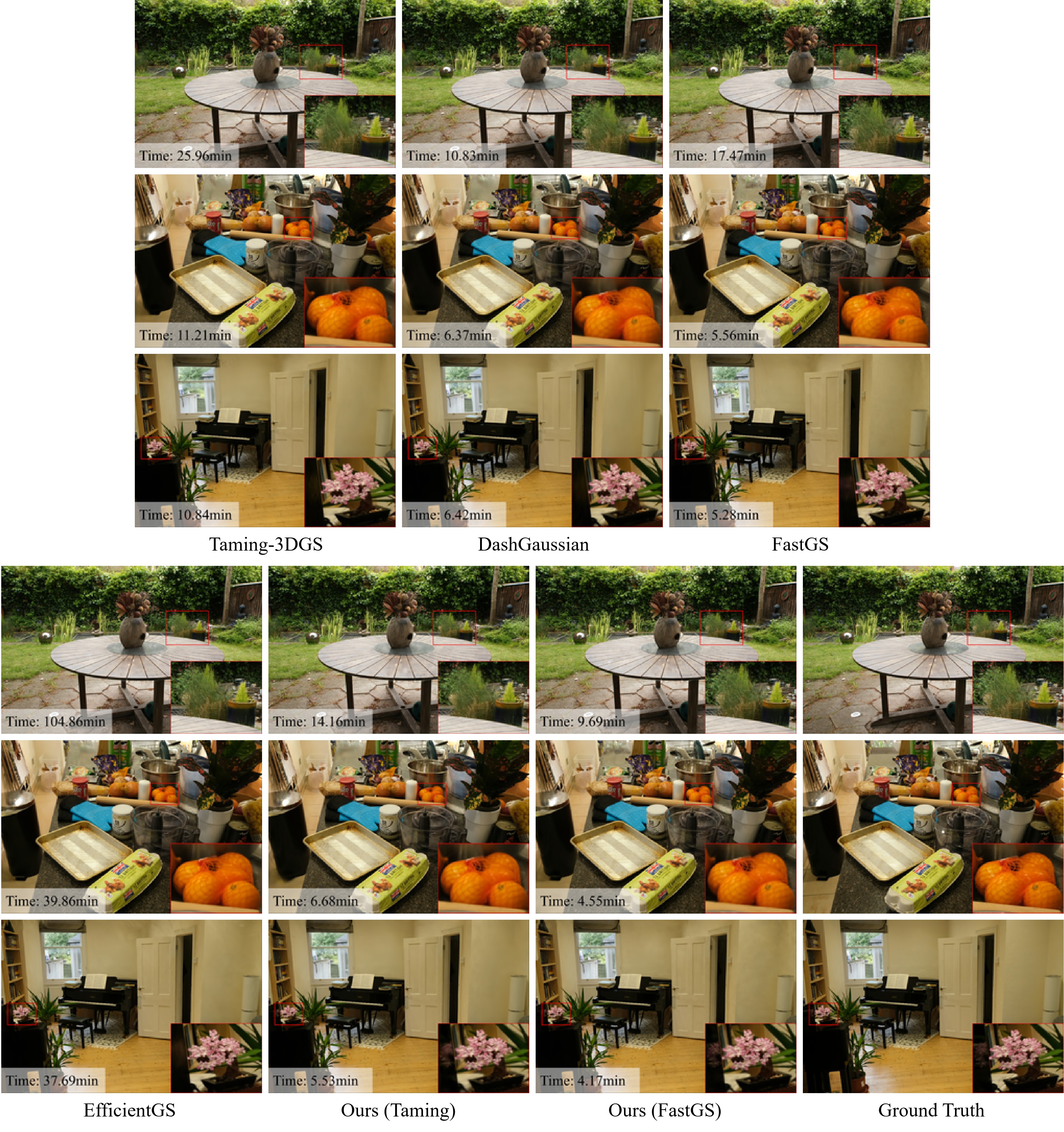
A key bottleneck in 3D Gaussian Splatting training is the continual growth of Gaussian primitives, which increases optimization cost and slows convergence, especially at high resolutions. We propose Laplacian Frequency Hierarchies, a simple yet efficient 3DGS scheme that combines Laplacian image decomposition with coarse-to-fine, frequency-staged training. After fitting lower-frequency structure, we archive the corresponding Gaussian field so that subsequent fields can optimize higher-frequency residuals without carrying the full primitive burden, and we compose the rendered components in the image domain via a Laplacian-style reconstruction at inference time. This design reduces the number of active Gaussians during training, lowering optimization overhead and accelerating training. The proposed scheme is plug-and-play and orthogonal to prior 3DGS accelerations: it can be directly combined with strong backbones such as Taming-3DGS and FastGS to improve training speed with competitive reconstruction quality.
Method
Laplacian-GS decomposes supervision into frequency bands and optimizes a separate Gaussian field for each stage.
Demo
Results
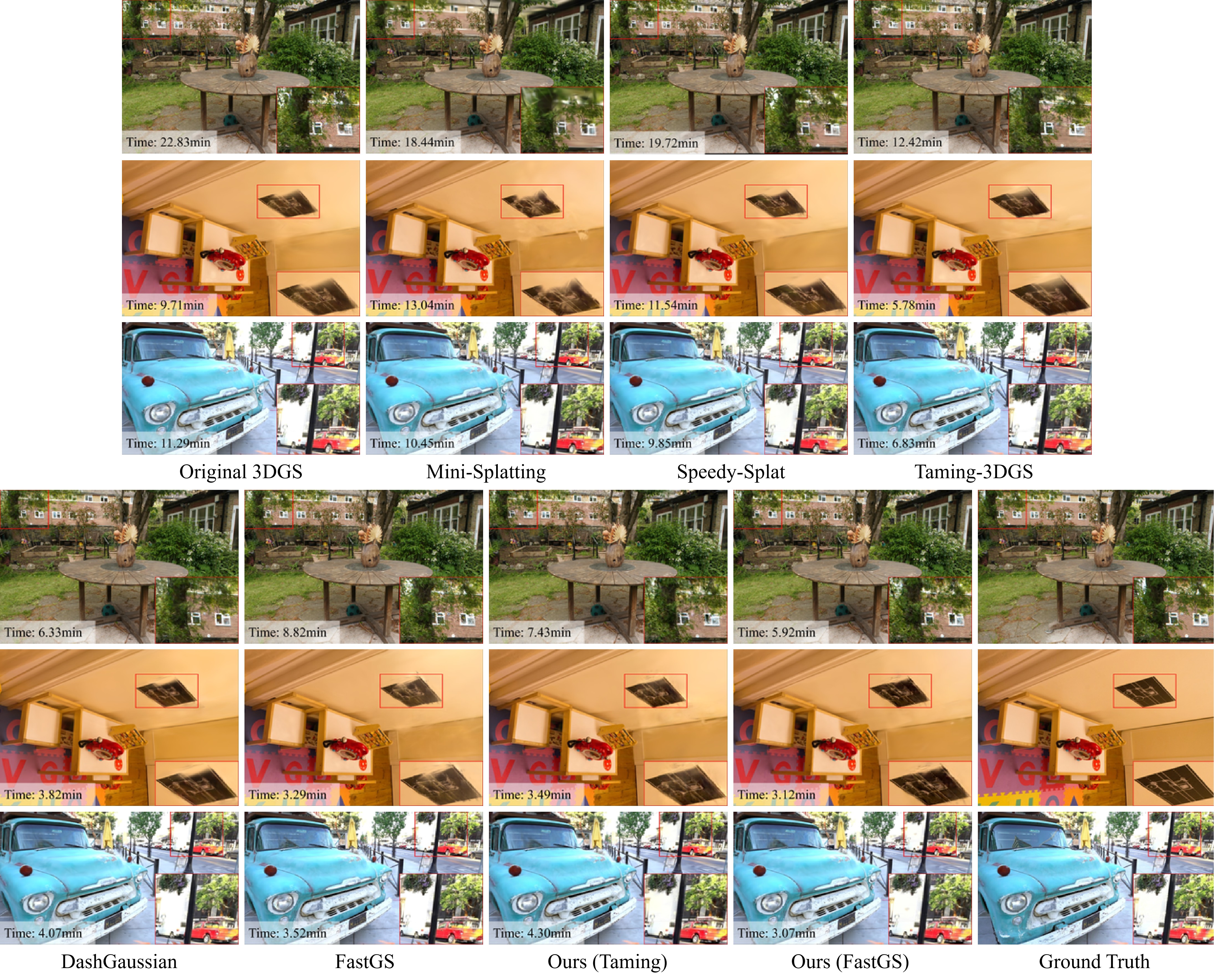
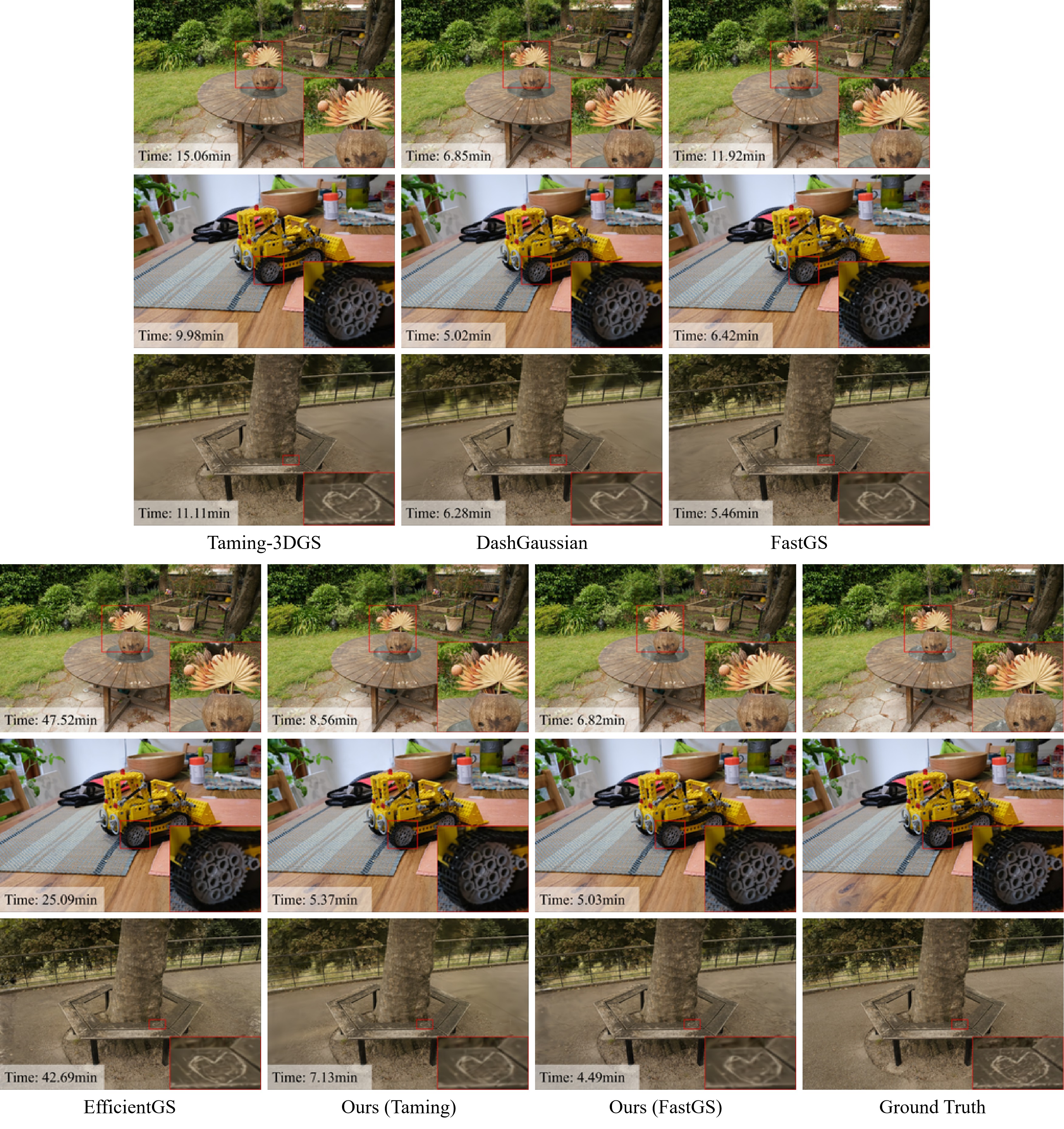
The released scripts reproduce the Mip-NeRF 360 1K setting with FastGS and Taming-3DGS backbones.
| Backbone | Script | Setting |
|---|---|---|
| FastGS | run_mipnerf360_1k_fastgs.sh |
Mip-NeRF 360, 1K/1.6K resize convention |
| Taming-3DGS | run_mipnerf360_1k_taming.sh |
Mip-NeRF 360, 1K/1.6K resize convention |
Acknowledgement
We would like to thank the authors of the open-source projects Taming-3DGS, DashGaussian, FastGS, and 3DGS for making their implementations publicly available.